
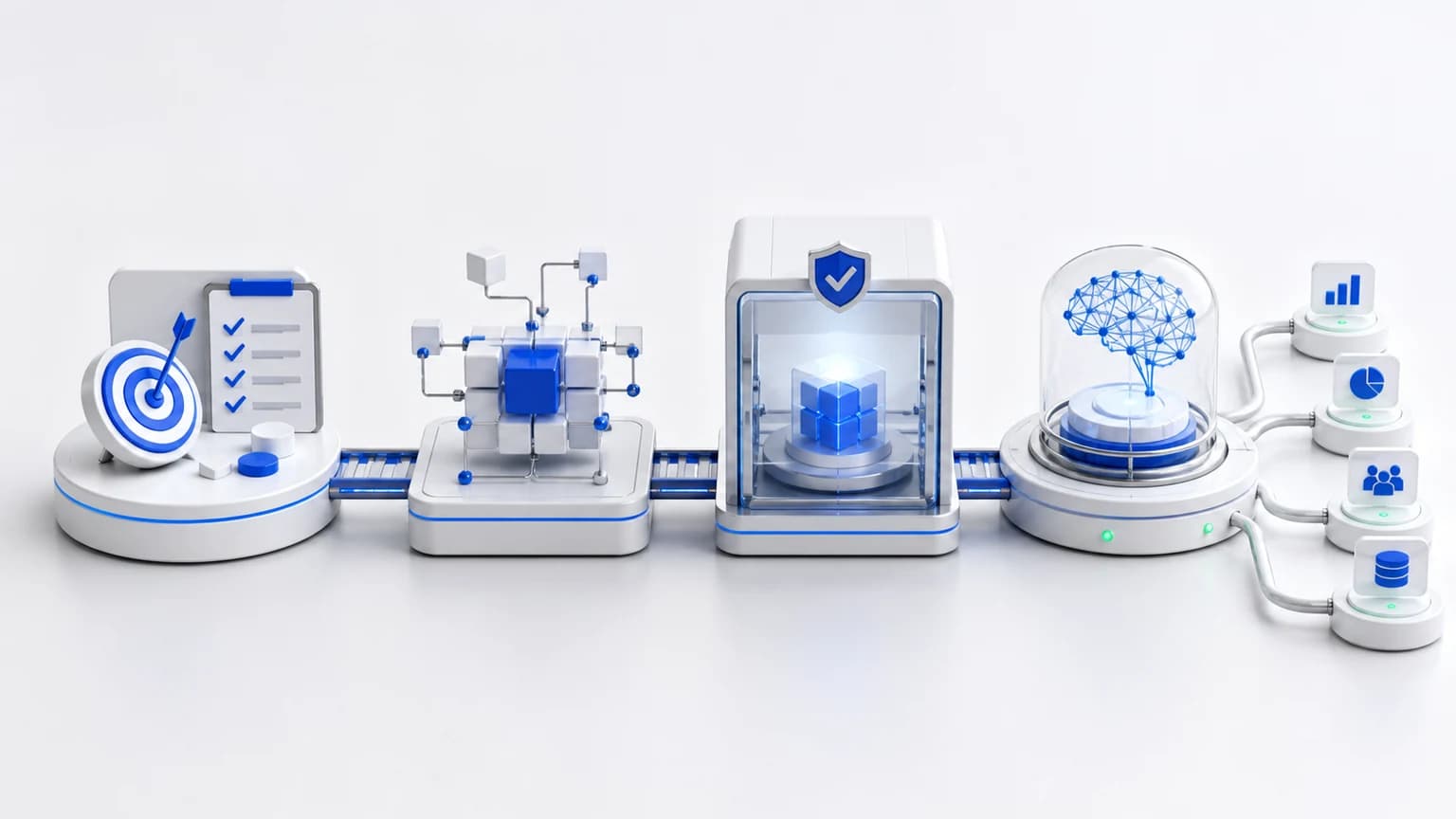
A reliable business agent combines a limited objective, identified data, authorised actions, controls and continuous measurement. Treat deployment as a process change, not a model installation.
Seven deployment decisions
- Define the business outcome and baseline.
- Choose assistant, copilot or supervised-agent autonomy.
- Govern documents and RAG sources.
- Apply least-privilege access to CRM, ERP and APIs.
- Test edge cases and failures.
- Train users and explain AI interactions.
- Track quality, adoption and full operating cost.
Move from an idea to an operational scope
Document the current process, monthly volume, users, systems, available data, common errors and expected outcome before selecting a model. This baseline makes value measurable and exposes missing data or ownership.
Set autonomy according to risk
Start with read-only access or a draft submitted for human approval. Allow execution only for clearly authorised and reversible actions. Sensitive, uncertain or exceptional cases should be escalated with their context and sources.
Test and measure in production
- Quality on a representative test set.
- Processing time and manual rework.
- Tool errors and human escalation rate.
- Actual adoption by the intended users.
- Cost per completed and accepted operation.
France Num recommends a progressive approach based on concrete business needs, clear objectives and employee involvement. Official guidance: https://www.francenum.gouv.fr/guides-et-conseils/intelligence-artificielle/comprendre-et-adopter-lia/comment-deployer-lia